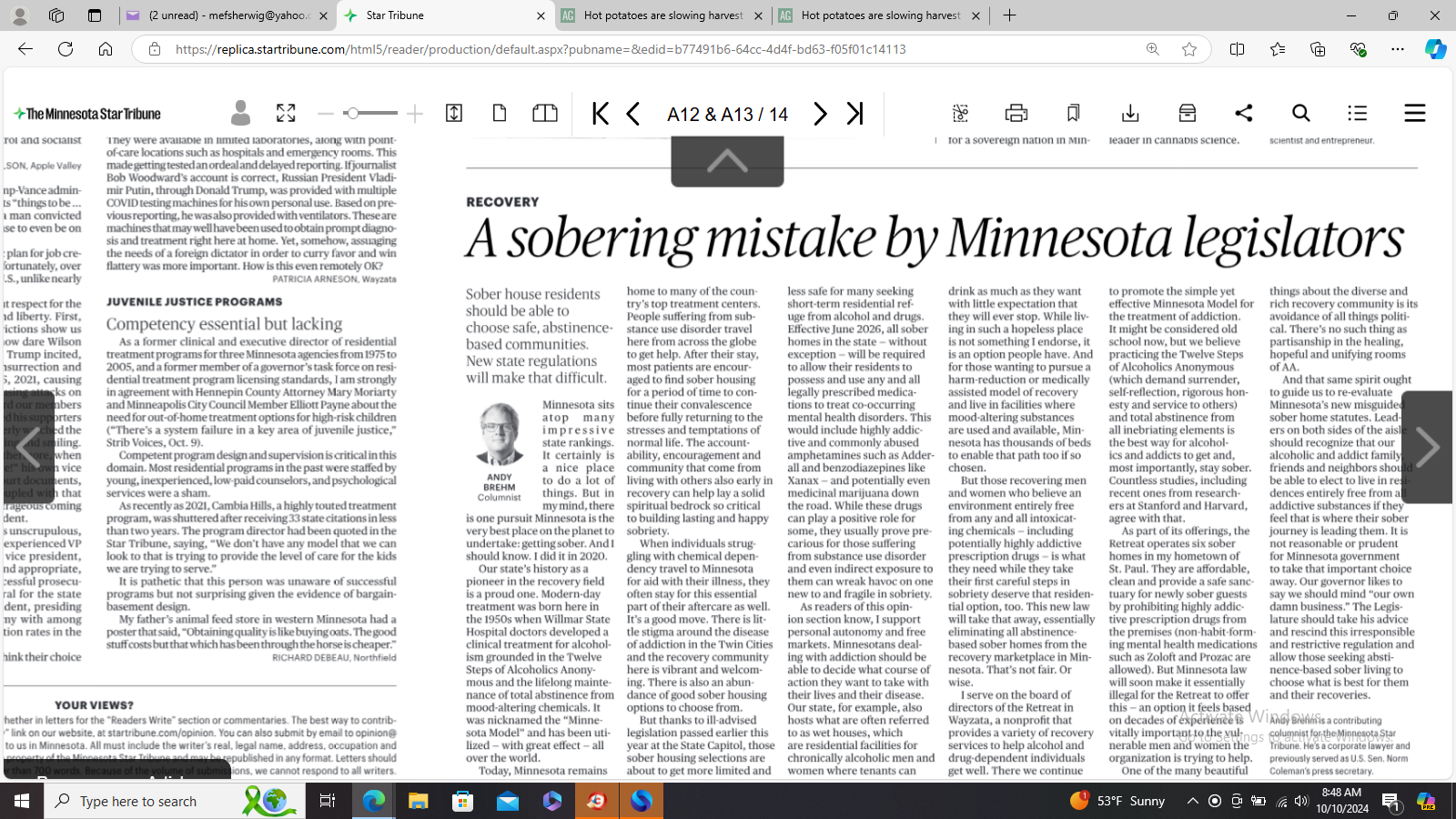
Thousands of Minnesotans a year rely on NUWAY’s program that pairs addiction treatment with a monthly housing subsidy, but it might not be around much longer.
Singer Jelly Roll performed a new song for the first time on Saturday Night Live tv show last night entitled Winning Streak. It’s an inspiring song for those of us in recovery and for those who need to be in recovery. Here’s the lyrics:
The broken glass of a bottle makes a jagged rock bottom Right now I got two shaky hands, one way to stop it And I haven’t touched a drop in seven hours, three minutes Finally sobered up, I really want to quit quitting Sweating in an old church basement, wishing I was wasted I never thought I’d say this (“Hello, my name’s Jason”)
[Chorus] I’ve been losin’ myself, I’ve been losin’ my mind I was standin’ in the rain just trying to stay dry I was so ashamed, to be in this seat I met a man who was twenty years clean He said, “Evеrybody’s here’s felt thе same defeat” Nobody walks through these doors through a winning streak Hold on, hold on Just hold on, hold on
[Verse 2] A broken man in the mirror, can’t look at me ’cause he’s guilty And I swear for the last couple months, that mother— tried to kill me By the time I saw it coming, it was done already It’s hard to run from it when it runs in the family A problem with a thousand more it’s causing Man, it’s all exhausting This is why I walked on (Thank you, all)
[Chorus] I’ve been losin’ myself, I’ve been losin’ my mind I was standin’ in the rain just trying to stay dry I was so ashamed, to be in this seat I met a man who was 20 years clean He said, “Everybody’s here’s felt the same defeat” Nobody walks through these doors on a winning streak, yeah Yeah
[Bridge] Im tried of being broken Im sick of feeling hopless Way down here at my lowest And the end of my rope, and the end of my rope So what do i do? So what do i do? What do I do?
[Chorus] I’ve been losin’ myself, I’ve been losin’ my mind And I was standin’ in the rain just trying to stay dry I was so ashamed, to be in this seat ‘Til I met a man who was twenty years clean He said, “Everybody’s here’s felt the same defeat” Nobody walks through these doors on a winning streak, hey Hold on, hold on Hold on, hold on
I would add ‘a day at a time.’ I’ve known many people, young and old, in my AA circles over the years trying the ‘easier, softer way’ by using for-profit ‘recovery’ plans, other AA alternatives that basically advocate controlled drinking, continued pot use and relying on fellow enablers to, in effect, continue using mind altering substances. These poor folks are all chronic relapsers.
Over and over again we welcome them back, heads hung low, knowing they’ll do it all over again once the memories of their degradation fade and their unreconciled problems seep back into their consciousness. We always welcome them back as we don’t shoot our wounded. Some do eventually find long term recovery if they work the program. Some die.
The Big Book destroys the fantasy of controlled drinking/drug use by addicts head on, “Most of us have been unwilling to admit we were real alcoholics. … The idea that somehow, someday he/she will control and enjoy his drinking is the great obsession of every abnormal drinker. The persistence of this illusion is astonishing. Many pursue it into the gates of insanity or death.”
When I first read these words in 1986 a chill ran down my back because I knew the book was talking about me. Then I thought, ‘I do not want to be one of those people falling toward ‘the gates of insanity or death.’ I’ve remained close to AA ever since and have received long-term sobriety.
Most folks know if you are serious about recovery you go to AA and work the program. It’s worked for countless millions for nearly 100 years.
I recall in recent decades, Minnesota and Wisconsin have been the nation’s No. 1 and/or No. 2 top binge drinking states. This chart seems to indicate we’ve made some progress. Good.
Plus: Peer recovery system to receive more oversight to prevent abuse
Saw this on local TV yesterday. The numbers represent DEATHS! More evidence for the need for AA, but also NA. I went to NA in my early sobriety and am glad I did. I quit drugs (I was mostly a pot smoker, another legal drug now) a year before I quit drinking and just started drinking more. I could not quit drinking, so started AA. Been sober decades now. Sure hope more folks find their way to NA before they can’t.
Alcohol Related Deaths (from the National Center for Drug Abuse Stats)
In the United States alone, there are roughly 261 alcohol-related deaths everyday.
Key Findings
95k—Number of alcohol-related deaths in the United States annually.
10.5K—Number of drunk driving deaths in the United States annually.
47.5k—Number of deaths attributable to the long term health failure from drinking.
Drug Overdose Death Rates
Drug overdose deaths are up 30% year-over-year.
Key Findings
96k+—Over 96,700 people die from drug overdoses in a year.
72%—Opioids are a factor in 7 out of every 10 overdose deaths.
1M—Drug overdoses have killed almost a million people since 1999.
Saw this little gem, below, on CNN the other day about how the medical community has viewed alcohol over the years.
This is from the Feb. 4 Star Tribune about treatment centers closing, scaling back, public and private. That tells me AA/NA is even more important now than ever. Come to AA/NA, its free (only voluntary donations are requested), its every day, morning noon and night and nearly in every city!
A day at a time is really where it’s at for sobriety.
Went to an AA meeting last night. Nobody mentioned the annual Dry January fad currently all over the media, but we did applaud for staying sober the last 24 hours. Now there’s a concept!
After booze corporations spend billions in advertising on corporate media outlets to get Americans to spend billions boozing it up for the holiday season, we now get the Dry January concept rolled out once again before corporations once again spend billions to get us to spend billions on booze for the summer booze binge season. What a circus.
One TV network this morning did a full report on Dry January, presenting screens full of tips how to get and stay sober, the benefits of sobriety, even a few people who are doing Dry January and one woman who has stretched one month of sobriety into several years of sobriety. Congrats. That’s a good start. No one mentioned, however, getting involved in a ‘support group’ (AA), but I’m not sure they need to. Most people know about AA. Perhaps the TV station was honoring AA’s tradition of ‘attraction rather than promotion’ ?
So, after the Dry January flash in the pan fad fades, we’ll be here, offering meetings, real help to stay sober day after day and handing out sobriety birthday medallions to those who had the courage to admit they have a problem and to ask for help to deal with it…one day at a time.
Pot possession, use and growing becomes legal in Minnesota August 1, with retail sales starting in about a year or so. Now, this is an AA site, not NA, but the two are connected, as most of you know. Here’s an example: A few months ago I was talking to a buddy at an AA meeting here in the Twin Cities about Minnesota legalizing pot. I am a recovering pot smoker as well as recovering drinker, as is my buddy. He said a few years ago when he was a few months sober he learned a state out east had legalized pot. It just so happens the man’s daughter lived in that state, so my buddy decided to go ‘visit’ his daughter. His real plan, however, he told me, was to get stoned. He got stoned and was soon back on the booze and with dire consequences.
I imagine Uptown and all the other AA houses (and NA houses) in Minnesota will start seeing more relapsers just like my buddy; that more struggling recovering alcoholics will take up the ‘marijuana maintenance’ program too. As with my friend, this path will lead to ruin for those of us powerless over booze and other substances. Of course, pot, like booze, wasn’t my problem. I was. Like legal booze, recovering people will just have to deal with it the best way we know how: go to meetings, read the Big Book, stay away from using people and places and work the steps. Its worked for me for 35 years!
Oh boy, its Dry January again and some in the Normie World are making their annual attempt to enable alcoholics to keep drinking. The photo below is of a story from today’s Star Tribune (written by the New York Times). It talks about “Mindful Drinking.” Sound familiar? If not, check out this quote from Chapter 3 of the AA Big Book:
“MOST OF US have been unwilling to admit we were real alcoholics. No person likes to think he is bodily and mentally different from his fellows. Therefore, it is not surprising that our drinking careers have been characterized by countless vain attempts to prove we could drink like other people. The idea that somehow, someday he will control and enjoy his drinking is the great obsession of every abnormal drinker. The persistence of this illusion is astonishing. Many pursue it into the gates of insanity or death.”
Ok, give controlled drinking a try, if you must (we hope you live through it), but when it fails, as it will for real alcoholics, the doors of AA will be open to you.
This reader letter appeared in the Jan. 4, 2023 Star Tribune newspaper, Twin Cities, MN. Wow, that’s a lot of money and, wow, taxpayers are sure paying for their profits. The writer says 60 percent of industry profits are from binge drinkers.
Wow, that’s a hell of a bar tab for excessive drinking, according to the Minnesota Department of Health, which just released the study, a first of its its kind in booze-soaked America. This head-pounding tab amounts to nearly $1,400/Minnesota resident. Uff da!
Most of the $8 billion comes in the form of lost productivity at work, or about $2.5 billion. The rest of the squandered treasure is from death, $1.7 billion; criminal justice, $959 million; health care, $915 million; and motor vehicle crashes comes it at a whopping $296 million. Ouch!
The study, as reported in the Star-Tribune newspaper, said binge drinking accounted for 75 percent of the carnage, no surprise to those of us in the fellowship of AA!
Now, Minnesota is adding THC to booze, whoa! Fire up the Big Books, keep the AA clubs open late and make some coffee, we AA’s have our work cut out for us!!! There is a solution Minnesota: free AA meetings. Meeting Makers Make It! It sure has worked for me, 35 years sober in October! Thanks AA!
Zoom meetings have saved many from pandemic-driven despair
Pandemic stress upped the death toll 25 percent, but don’t despair, AA is there!
Gee, if you ever needed a reason to join Alcoholics Anonymous, this headline is it. Personally, I’d rather admit I have a problem, ask for help and attend meetings/work the 12 Steps than be a corpse.
Just imagine the death toll number had there not been Zoom AA meetings during this pandemic? I know I relied on them, and I’ve been sober since 1987. AA is amazing. Case in point: I was unable to make my usual meetings for 12 days. Last night, I hit an Uptown Club online meeting and told my wife afterwards, “There’s nothing like hitting a meeting after missing them a while and realizing all over again how much I love AA.”
Any why not. AA saved my life. But more than that, AA made my life the mostly great ride it has been. There were quite a few new people and relapsed folks attending last night’s meeting, and no doubt other meetings around the country. I bet a few of these folks would have been counted in the next booze death toll had the hand of AA not been there to help them saves themselves.
I’m proud that AA, which was founded nearly a century ago when computers and the internet weren’t even dreamed of, has adapted to this pandemic and used technology to help save countless lives.
After last night’s meeting ended, I repeated one of my favorite AA mantras, “Meeting makers make it,” which elicited a heartfelt amen from one attendee. In 100 years, this one AA truism hasn’t changed, and it won’t in another 1,000 years.
The trick to life is not always winning, but getting back up once you fall.
I’ve been watching the Olympics this week. Seeing one American skier, who has won many races and medals, wipe out, and sobbing on the sidelines in front of the whole world reminded me of that age old saying, “the trick to life is not always winning; but getting back up once you fall.”
As a long-term recovering substance user, I can relate. This skier’s most public defeat was a good reminder about my own life, and that of others, because I, too, crashed and burned at one time in my life after a good run of victories.
You learn a lot about yourself, and others, not so much when they win, but what they do when they lose. Some pout, give up and either die quickly or slowly, giving up on themselves and life. But others, myself included, figured out we had some problems and reached out for help to solve them (Step 1 and 2). I accepted other help in addition to AA. I did what it took.
The AA Big Book says there are those who do not have the capacity to be honest with themselves, that there’s little hope for them. I’ve always heard it said those people are to be thanked because they serve as a warning to the rest of us about what can happen if we don’t accept help and recover.
I chose to admit I had some problems, get up, dust myself off, reach out for help and live……..and live I have! Its been a good run so far (after that first year or so, anyway), and as long as I go to meetings, work the program and hang with/help others, this good run will continue!
The Case of Sheriff Hutchinson
Speaking of publicly ‘crashing and burning,’ what do you think of Hennepin County Sheriff Dave Hutchinson’s experiences of late?
You may recall on December 8 a very drunk (twice the legal limit) Hutchinson crashed his county-owned vehicle at some 120 mph, and was lucky to survive. Approximately 120 Minnesotans died in alcohol-related crashes in 2021.
Many called for Hutchinson to resign. One state senator said, “I believe in second chances when it comes to chemical dependency, but the path to redemption requires accountability.”
Hutchinson was convicted of fourth-degree DWI, and agreed as part of his plea deal, to undergo random drug and alcohol testing. He’s also forbidden from drinking alcohol and getting any driving violations. He’s said he has stopped drinking. Hutch has since agreed not to run for re-election, but won’t resign his current term.
I hope he chooses the path of recovery.
Another Resource
Saw this on one of the endless news reports of people dying from substance abuse. Maybe it will help someone: The Substance Abuse and Mental Health Services Administrative Hotline: 1.800.656.4673.
Country singer Walker Hayes just released his song “AA” last November. The lyrics are great. Its good music stars discuss their sobriety struggles in public because it helps others deal with their lives. Such efforts help ‘mainstream’ talking about alcoholism and recovery, both to those in (or in need of) recovery and the ‘normie’ community.
The song comes out at a time when many in this country are just losing it (alcohol and drug abuse, deaths are skyrocketing) because of the pandemic, economic and political turmoil. There is an effective, free alternative to killing yourself with alcohol and drugs: AA!
The song was co-written by Hayes with Shane McAnally and Luke Laird. It expresses Hayes’ anxieties as a dad, his love for his wife Laney, and his own sobriety struggles, fears and doubts.
Hayes said in one interview, “At the end of the day, we are all just doing the best we can. … I’ve struggled with alcohol abuse, and sometimes I wish I didn’t need AA, but I do. I think a lot of people can relate to that. I’m just trying to be the best dad and husband I can be. It’s not easy all the time, but my wife smiles a lot and my kids are growing up with more than I had, and that’s a really good thing.”
Here are the song’s lyrics:
Alright Coffee cup cold and black Wish it had a little shot of jack ‘Sides that, can’t complain Just tryin’ to do the dang thing Might change the oil in my truck I ain’t paying no thirty-five bucks Kids need shoes, mama needs Levi’s
And I’m just tryna keep my daughters off the pole And my sons out of jail Tryna get to church so I don’t go to hell I’m just tryna keep my wife from figuring out That I married up and she married way way down In Alabama where they love Nick Saban Tryna write a song the local country station will play Hey, I’m just tryna stay out of AA
Ooh Well I gave up Skoal and cigarettes Now I’m just hooked on Nicorette Trying not to be like my old man But the older I get the more I am Tryna get paid and a little love made, y’all Hey y’all, at the end of the day, y’all I’m just another John Deere guy (hey) Up on a tractor
Tryna steer my daughters off the pole And my sons out of jail (sons out of jail) Tryna get to church so I don’t go to hell I’m just tryna keep my wife (hey babe) from figuring out (I love) That I married up (you’re so fine, girl) and she married way way down In Alabama where they love Nick Saban (alright) Tryna write a song the local country station will play (I’m just tryna write a song) Hey, I’m just tryna stay out of AA
Ooh ooh ooh Come on babe, right here Check it out
Ooh, tryna stay out of AA everyday One step at a time, y’all Life’s hard, family’s weird Sometimes you just need a beer Can I get an amen (amen)
Unity, Service, Recovery: Get to meetings and work the program together. The power of AA starts in a meeting with others of our kind. This is a power greater than addiction.
The pandemic has brought about many challenges to the recovery community, and those that need to be in recovery: increased rates of drinking, drugging, death, incarceration, suicide, abuse, crime, you name it, the panoply of human dysfunction.
Long ago, instead of whining about the pandemic, I just accepted it and figured, like others, it was this generation’s turn to suffer. This is nothing new to AAs: AA began in the 1935 during the Great Depression and just before World War II began in 1939 with the German invasion of Poland. Times were much tougher back then, and like today, the full menu of human suffering was on parade.
There’s one big difference, however, because today we have a huge network of AA and AA-type meetings, public and private support for treatment and mental health programs, etc. All you have to do is reach your bottom, decide you want to live and go to a meeting. Like liquor stores, there’s an AA meeting on just about every corner! Yes, its still hard to “make a decision,” as Step 3 begins, but that’s up to you. “You can lead a horse to water, but…..”
In my sobriety there’s not one challenge life has thrown at me that the program of AA has not helped me get through successfully, a record that’s decades long (continuous) and counting. Now that’s a testament to the power of AA you can put in the bank.
So, give it a try. And as they always used to tell me at my first AA club in Denver when I hesitated to stay in AA, “If AA and sobriety are not for you, leave, and your misery will be cheerfully refunded!” I’m certain there were a few knowing looks and smiles thrown in there too!
Practicing HALT helped me a lot in early sobriety.
I don’t recall who first told me about HALT in early sobriety, but thank goodness they did because this quick, little mental reminder to take care of myself helped a lot in those early years when I was neglecting my mental, spiritual and physical health.
Like most, I came into AA a mental, physical, emotional and spiritual wreck. I was just divorced, partying like I was 16 (I was 31) and had a political-type job that called for fighting the world and included a lot of drinking during work hours. I was hungry, angry, lonely and tired most the time.
When I stopped drinking and drugging, I became even more aware of my degraded physical and mental health. Yet, I didn’t have many of the skills needed to take better care of myself. The AA people around me knew this and started helping me. One of the tips they gave me was HALT. I didn’t have a clue what it was, so they explained it. They said if you are in any of these four states, (hungry, angry, lonely or tired) it was time to get into ACTION ASAP!
Desperate to save myself, I used HALT all the time, sometimes hourly, in my struggle to right my capsized ship…..and it really worked because I needed it, believed it and worked it! Honestly, I was surprised at how far gone I was that I needed to constantly remind myself just to take care of these four basic human needs. It was shocking. The shock helped me realize, though, that I had problems and needed AA’s help and the help of others as well.
HALT also really helped me commit to AA and to healing myself.
HALT doesn’t come up in my mind very often anymore now that I’ve been sober for decades, but when it does, I just smile to myself and take care of the problem. Thinking of HALT now gives me a nostalgia feeling for those dramatic, early days in AA and the loving people that helped save my life and helped me come back to life.
“It works if you work it!” they’d said at the meeting’s end. How right they were.
Minnesota Governor Walz recently announced that state indoor/outdoor capacity limits and mask requirements are over! However, other jurisdictions (such as the City of St. Paul where Uptown House resides) and private entities may retain these restrictions.
Starting May 28, Uptown House will be returning to our pre-pandamic table and chair setup, and expect the St. Paul City mask mandate to expire soon. We continue to monitor the community situation and look forward to the day that we will safely welcome back all of our regular in-person groups at the previous schedule.
Online meetings were great during the pandemic, but now that most vulnerable people are vaccinated, its time to get back to in-person meetings.
Online AA meetings through Uptown House and other venues really helped me get through a bleak pandemic winter. But now that most folks vulnerable to covid are vaccinated, its time to get back to in-person meetings at Uptown. Face-to-face meetings is how AA is meant to be practiced. Its a big part of AA heritage.
I had a good conversation with Uptown Steering Board Chairperson Peter K. this morning on this very subject, and he agrees. I’m 65 and fully vaccinated (Moderna). I’ve been to three in-person meetings at Uptown the last two weeks. There have been 6-10 people in attendance. All wore masks and maintained a 6-foot distance. While surface-borne infections are now seen as unlikely by health experts, Uptown House also has hand san and washes down chairs after every meeting. Now, as of this update (May 17), these procedures are no longer required by the state health department, but still are by St. Paul.
In-person meetings are good for old timers like myself, but especially for newcomers too. I don’t think I would have remained sober in my early days without in-person meetings. Also, Uptown House needs in-person meetings to remain a functional, viable AA destination in every sense of the term.
At this point, everybody should know if they may attend in-person meetings or not. We can make that judgement now for ourselves. Minnesota Department of Health guidelines now allow for indoor, in-person gatherings for vaccinated, masked and distanced folks for example, in restaurants and bars.
The recovery community needs to get back to normal. When I was a newcomer I was disconnected from myself and others. This was a big barrier to sobriety and living a normal life. A big part of my short-term and long-term recovery was getting back in touch with myself, other recovering people, family and friends. This process is best facilitated by face-to-face interaction. There is no substitute for social intimacy. We are social creatures. We wither without it.
In an effort to walk my talk, I’ll be helping re-open the popular Saturday 10 a.m. meeting starting April 8! This may take time, but I believe its necessary on many levels. I hope our readers will take similar steps to help Uptown House and its members leave the pandemic lock-down behind us and get back to AA’s longtime, proven and valued heritage of face-to-face meetings. We hope other, previously regular in-person meetings will also get running again.
Sobriety isn’t always like this idealistic photo illustration, but it sometimes is, especially when lived a day at a time.
I saw a headline the other day that ‘stable’ recovery takes 4-5 years. Hmmmmm, sounds like ‘normie’ talk.
The only reliable account I can give of stability in recovery is for myself (in the true tradition of AA!). My last drink was in October 1987. I felt stable in my recovery by October 1989, or about two years. My recovery felt stable once I had fully embraced the sober life, when AA became the guide for my life, but NOT MY LIFE per se.
AA became the guide for my life after two years. I still tell people for me, AA is one part counseling, one part family and one part spirituality — all valuable things for anyone, but especially for a lost, wounded person like I was by the fall of 1987.
I don’t know the clinical definition of ‘stable recovery,’ and I don’t care. I guess if you reach the point I did (in my case, after two years) then you are stable in recovery no matter what the time interval. People are so different; our histories are so different; our paths to recovery are so different that its ridiculous to define stable recovery in terms of a hard and fast time interval. Or, as our new president would say, “come on!”
Besides, as I learned in AA, comparing my insides to someone elses outsides is a dangerous and ultimately illegitimate thing to do. Its never an accurate or useful comparison to make, and often harmful.
Is someone who can only put together a month of sobriety therefore considered stable in their first week? Can someone who was sober 15 years, as an old friend of mine was, have been considered in stable recovery at any time if he went back out to use? You can see the utter futility of trying to define ‘stable’ recovery.
Of course, most AA folks know the answer to the puzzle of what is a ‘stable’ recovery: Its just one day. AA is a day at a time program! Twenty-four hours is all we get to claim for our stable recovery no matter how long we’ve been sober. Lose track of this fact and you imperil your recovery.
So, here’s to today folks. May it be a sober day, a good day! Hard not to be when its spring and the pandemic is getting its rear end kicked one vaccine at a time! Speaking of which, I’m covid immune by April 11, having had my second vax last week. So, after the 11th its back to in-person meetings for me, masked up (Uptown House rules), of course!
As the vaccine rollout continues, in-person meetings for all ages is on the horizon.
I’m getting my first covid vaccine March 1. That’s great for me, but what this really indicates for the wider AA community, and specifically Uptown House, is meeting normalcy is on the horizon.
Minnesota’s Governor Walz believes 70 percent of wise elders (those 65 and over, including myself) will be vaccinated by the end of March. He said vaccinators can then start vaccinating others. The Johnson and Johnson vaccination will be going into arms soon and the feds are really ramping up production of the other two vaccines and vaccination availability. President Biden believes we’ll be back to something resembling normal by Christmas. Let’s hope.
One of my favoritie AA matras is “This too shall pass.” Its happening: this miserable, deadly pandemic is finally starting to get its a__ kicked. Once my immunity is complete, about mid-April, I plan on attending in-person meetings at Uptown House. I can’t wait, and I know others will be joining me.
Let’s remember those who have passed or have been injured both physically and mentally by this horrible pandemic. We know there are more victims to come, but I hope there won’t be too many more.
I’ve been told Uptown House has done a good job with social distancing, masking and cleaning during and after in-person meetings. I can’t wait to get back, and I know many others can’t either.
There will be other challenges for the recovery community coming our way in the years to come. There always is. But we can handle it. We stuck together during covid through Zoom meetings and other adaptations and most of us are moving ahead sober, making progress, coping today and looking forward to a better tomorrow.
Drip by drop, spring is coming, and with it, hope.
I love AA, even after decades sober I’m still discovering new cliches. I attended a new Zoom meeting this morning, for example, and heard one man say, “Inch by inch, life’s a cinch; yard by yard, life is hard.” I’ve never heard that one. I love it.
I guess put another way it speaks to other AA cliches, Easy Does It or take life One Day at a Time. Life, most the time, happens an inch at a time. The calamitous, fast changing moments are few. I look at the natural world around me and the same law, not surprisingly, applies: time and nature move slowly most the time, in small, imperceptible increments.
When I accept the incremental nature of life, my hurried primate mind must then, if it wants to stay sane, accept the fact I will have to wait a bit, in most cases, for the good thing to come. In a word, I must have hope. Hope is always a valuable commodity, but it is really needed during a winter pandemic when so many folks are struggling, including me.
But there is hope, especially today for on this day the long, cold, dark month of January is finally over. Native people spoke in terms of moons to delineate a month’s time. Some called January the ‘hard moon.’ I’m very glad the hard moon has passed. In many European cultures, February 1st is celebrated as the first day of the spring to come. If I look around, its true: the eagles and great horned owls are nesting (check out the Minnesota Department of Natural Resources Eagle Cam); the chickadees are doing their territorial songs in the backyard in preparation for nesting and we’ve gained a full HOUR of daylight since the Winter Solstice December 21 (the shortest day and longest night of the year).
Spring is coming “inch by inch” and hope has us tightly in its arms.
AA online meetings, working the AA program still the best way to get, stay sober
Hang in there folks, the vaccine is coming and in-person AA meetings should be coming later in 2021. (Photo by Anna Shvets on Pexels.com)
by Mark H.
Since the most recent partial lockdown here in Minnesota, there has been a large increase in attendance at Uptown House online meetings. That’s good.
Also, the rate of covid vaccination should really take off in 2021 so we can finally ‘stick a fork’ in this pandemic and get back to normal, in-person AA meetings later in 2021. Hang in there folks, good, big, change is on the way.
Until then, we’re still dealing with this mess. Here’s the latest:
The Centers for Disease Control discovered 31 percent of the all adults, sober or not, that it surveyed this summer were struggling with anxiety and depression related to COVID-19. In a separate study, RAND Corporation found the frequency of alcohol consumption of adults over 30 grew by 14 percent; women increased their heavy drinking episodes by 41 percent.
A story on the Fox 9 website quoted John Curtiss, treatment center owner. “Its hard when you have a disease – alcoholism – that requires connection, and COVID that requires social isolation, that creates a whole set of unique challenges.”
Lydia Burr, director of clinical services at Hazelden Betty Ford’s St. Paul campus said, “We’re seeing sick people get sicker. People are really struggling with their mental health, their depression and with the anxiety. And then there is that added layer of stress that exists in society right now because of the pandemic that is layered on top of that, and it’s really exacerbating the problems that somebody might have.”
Fox 9 television started broadcasting a three-part series December 28 entitled “Hidden Crisis.” The story mentions AA, among others, as a resource for help. Here’s the links to all three Fox 9 stories:
Thanks for Meeting Uptown House Pandemic Fundraising Goal
You did it! Uptown House’s faithful members helped us reach our goal, $15,000, and even exceed it! The Uptown Steering Board and Foundation thanks everyone who contributed as the House was facing a serious deficit thanks to the pandemic driving down attendance and, therefore, contributions. The Uptown House now has an adequate prudent reserve of funds to make sure we can keep the house open and offer safe meetings for the foreseeable future.
We’re keeping the campaign open for the next week, so if you haven’t contributed and would still like to, please do so (see the Uptown website). As always, any funds not used for the basic operation and maintenance of the house above the prudent reserve will be donated to St Paul Intergroup and the AA General Service Office in NY. Please give what you can, and have a safe and sober New Year.
Thanks Earl W.!
Speaking of money, many thanks to retiring Uptown House Steering Board volunteer treasurer Earl W. He did a lot of work keeping the House finances in order. We all owe him, and others who recently left the board, a big THANK YOU for a job well done.
And finally……
Thought for the day from pioneering Swiss psychiatrist and psychoanalyst, Carl Jung:
Until the unconscious becomes conscious, it will direct our lives and become fate.
The words we use with our fellows in recovery can have many different impacts. Choose them carefully.
I don’t always buy into political correctness, which can devolve into thought/speak control, but neither do I believe in using abusive language.
A recent Zoom meeting with the Addiction Policy Forum shared the following. Some of this makes sense to me, some seems a stretch. Make up your own mind:
Words can hurt, sometimes for a lifetime, depending on what’s said and who utters them. I get some of the above tweaks. The Zoom was on fighting the social stigma foisted on and discrimination against recovering people. We all deserve a second chance.
Its funny, many of us in AA got the stigma thing a long time ago. I sobered up (a day at a time) in 1987. In my first year I started introducing myself in meetings as a recovering person, not just an alcoholic and addict. I make my living writing, so words are important. Writer Mark Twain said the difference between the right word and the wrong word is the difference between lightening and lightening bug!
So, with Twain in mind, I thought to myself in those early days, “To say ‘Mark alcoholic and addict’ didn’t make sense since I wasn’t using anymore.” True, there is no cure and once an alcoholic and addict, always one. But, I wasn’t just an alcoholic and addict anymore, I was, in fact, a recovering one. So, that’s what I say. Its more accurate and true and its a self definition that recognizes my new, albeit, daily status. It rejects stigma.
But, to each their own. “To thine own self be true,” it says on AA anniversary medallions. I’ll stick to that.
Uptown House Steering Board & Farewell Crysil D.
I just finished two years on the Uptown House Steering Board. I enjoyed it, am glad I did something to give back, but am ready to move on. Serving was my first post-retirement volunteer experience. It won’t be my last. I’ll keep doing a monthly column here if the board wants me to.
Board Chair Crysil D. is also leaving the board after two years of intelligent, dedicated, thoughtful service. The entire Uptown House owes her a debt of gratitude, especially for all the extra work she put in dealing with the pandemic. Thank you, sister, for leading us through this hard time!
Winter is a time for folks in recovery to reach out to each other, stick together and, sometimes, push together! Together we are stronger, more resilient.
If there was ever a time to stay connected to the recovery community (as if we needed an excuse), Winter 2020 is it!
The deepening cold and dark of a Minnesota winter is normally a harder time for the average Joe and Jane to keep on the level, but with a spreading pandemic, this winter is time to pull out all the tools in your sobriety and mental health tool box.
When using alcohol and drugs was my coping mechanism, winter was a time to use more. Now that I’m sober (33 years), I just use my recovery tools more. In that sense, I haven’t changed.
Minnesota Public Radio (11 a.m. daily) reporter Angela Davis recently hosted a show on sobriety. She reported alcohol consumption in Minnesota (already one of the top states for alcohol abuse) is up 14 percent due to the pandemic, with heavy drinking by women up 41 percent!
Davis interviewed a Twin Cities AA member, Terry, who has 45 years of sobriety. Terry said the Twin Cities AA community is coping well with the pandemic by offering 250 online meetings/week here’s also an increasing number of social distanced, in-person meetings available). He said calls for help to AA Intergroup (St. Paul Intergroup 651.888.6912) are up 100 percent since the pandemic. Better Intergroup than the bottle or the bong!
Other resources
MinnPost, an online news service to which I’m a donor, recently interviewed Tai Mendenhall, a licensed marriage and family therapist from the University of Minnesota Medical Reserve Corps.
Mendenhall urged Minnesotans who are struggling to connect with others ? even if it?s a weekly Zoom call with friends or family, and seek professional help if they need it.
Malcolm stressed that free, daily phone support is available to anyone experiencing stress through COVID Cares, a collaboration between the Minnesota Psychiatric Society, Minnesota Psychological Association, Minnesota Black Psychologists and Mental Health Minnesota. Just call 833-HERE4MN (437-3466) 9 a.m. to 9 p.m. every day.
So, if you’re struggling in life or with your sobriety, call an AA buddy, hit an online meeting and use other resources available. We can make it through this pandemic winter sober if we stick together. This winter and the pandemic too shall pass. There is another spring on the way!
Help is a few clicks away with a new, free sobriety guide from the Addiction Policy Forum.
Recently, the Addiction Policy Forum launched a national initiative to help folks navigate the complexities of addiction. The project includes a free, 100-page resource workbook, Navigating Addiction and Treatment: A Guide for Families; a national awareness campaign; and online resources to help families.
The guide is much more about DIY sobriety than paid treatment facilities, which have helped many. Many have found sobriety, including myself, by just going to free AA meetings, reading the AA Big Book and 12×12 and working AA’s 12 Steps.
The COVID-19 pandemic has meant more overdoses (alcohol and drugs) and more people struggling with addiction as we grapple with the stress, isolation, financial struggles, and lack of access to services. Now more than ever we need to make information about navigating this disease and accessing treatment as simple as possible, said Jessica Hulsey, Founder of the Addiction Policy Forum. ?Navigating Addiction aims to help all families that are struggling by providing them with free and evidence-based resources.
The guide was created by the Addiction Policy Forum with support from Indivior. The publication is disseminated free-of-charge to families in all 50 states. An Expert Review Panel composed of prominent researchers and physicians in the addiction field also contributed to the report, along with the Family Support Advisory Committee made up of family members with lived experience.
This is the Guide’s table of contents. Good stuff!:
What is Addiction? Different Types of Substance Use Disorders Addiction and the Brain Addiction is a Chronic Disease How Addiction Affects the Family Signs, Symptoms & Early Intervention Enabling vs. Helping and How to Set Boundaries Communicating with Your Loved One Getting an Assessment Evidence-Based Treatment Medications for Addiction Treatment What to Look for in Quality Treatment Recovery Support Caregiver Self Care Patient Pathways Resources Endnotes
To download this free resource, Google Addiction Policy Forum – Navigating Addiction and Treatment, open the site and click on the “guide” hotlink.